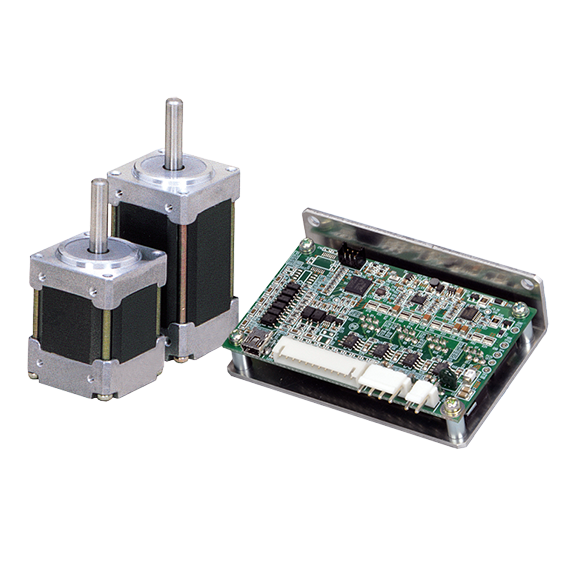
Simple positioning control by high torque and sensorless motors.
Abundant lineup correcsponding to various application.
Rotational speed of step motor is defined by pulse rate and its rotational angle is defined by the amount of pulses. These digital signals enable open loop control, which does not require feedback structure. On the other hand the unit step angle is defined by the mechanical structure of a rotor and a stator. The step motor is also called Stepping Motor, Stepper or Pulse Motor because no unified name is established. Tamagawa Seiki Co., Ltd. unifies to call it Step Motor.
Point : Mutual interaction of the permanent magnet and the gear-shaped electromagnet
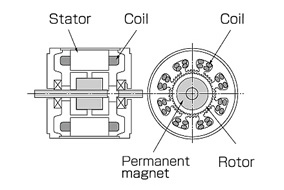
In the step motor, a cylindrical rotor rotates within a cylindrical stator. The rotor has a permanent magnet, and the outer periphery of the rotor has a toothed shape like a gear. On the other hand, the stator has a toothed iron core that roughly corresponds to the shape of this rotor (gear teeth). Wire is wound around the stator core to form a coil. An electric current is externally supplied to this coil (electric wire) to form an electromagnet, and the rotor rotates due to the interaction with the magnetic force of the permanent magnet of the rotor.
Point : Rotation of a step motor is controlled by switching current in the coils
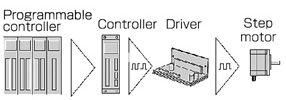
To rotate the step motor, switch the current supplied to the step motor coil to change the state of the electromagnet. There are multiple coils inside the motor, and rotation is controlled by combining the current supplied to those coils. The moment the coil current is switched, the motor's rotor rotates by a fixed angle. It is the driver's job to switch the coil current.
For driving a step motor, it is necessary to excite its windings by applying a DC voltage and current in sequence. Therefore, a step motor requires a proper drive. An oscillator, driver and DC power supply as shown in the right figure are necessary as minimum components.
For improving the angle accuracy and damping characteristics of a step motor, an optical encoder or other sensors may be added, and then a suitable amplifier for feedback may be needed.
Also, the damping characteristic can be improved by using a mechanical damper.
Step Motors / Drvers